         time_period  total_requests  total_items  compliance_rate  resistance_rate  poor_request_rate
 January - June 2019               2            2         0.000000         0.000000           1.000000
July - December 2019               3           14         0.285714         0.714286           0.000000
 January - June 2020               7           60         0.050000         0.900000           0.050000
July - December 2020               7           20         0.750000         0.000000           0.250000
 January - June 2021               7           12         0.333333         0.000000           0.583333
July - December 2021               6            7         0.000000         0.000000           0.571429
 January - June 2022               2            6         0.000000         0.166667           0.833333
July - December 2022               5            5         0.200000         0.400000           0.000000
 January - June 2023               7           58         0.051724         0.827586           0.120690
July - December 2023               5            6         0.833333         0.000000           0.166667
 January - June 2024               9           12         0.166667         0.250000           0.583333
July - December 2024               8           11         0.000000         0.454545           0.545455
January - June 2025 16 42 0.119048 0.619048 0.261905GOOGLE TRANSPARENCY ANALYSIS - KENYA
Digital Suppression Metrics: Kenya (2019–2025) Analysis of Google Transparency data reveals a sharp escalation in government intervention coinciding with the 2024/2025 protest windows.
Protest Spikes: Content removal requests spiked from a historic baseline of 2–5 requests to 9 in early 2024, 8 in late 2024, and peaked at 16 requests in Jan–Jun 2025, targeting 42 items.
Tactical Focus: Interventions shifted heavily toward multimedia and distribution networks, with YouTube (14 requests) and Web Search (7 requests) being the primary targets.
Stated Motivations: While “Defamation” (10) and “Privacy” (5) were frequently cited legally, explicit political vectors emerged via National Security (3), Government Criticism (1), and Violence (1).
Pushback: Google maintained strong institutional resistance. Legal/Policy compliance remained extremely low, with the vast majority of items receiving “No Action Taken” (Resistance Rate) or rejected as poor requests due to insufficient information.
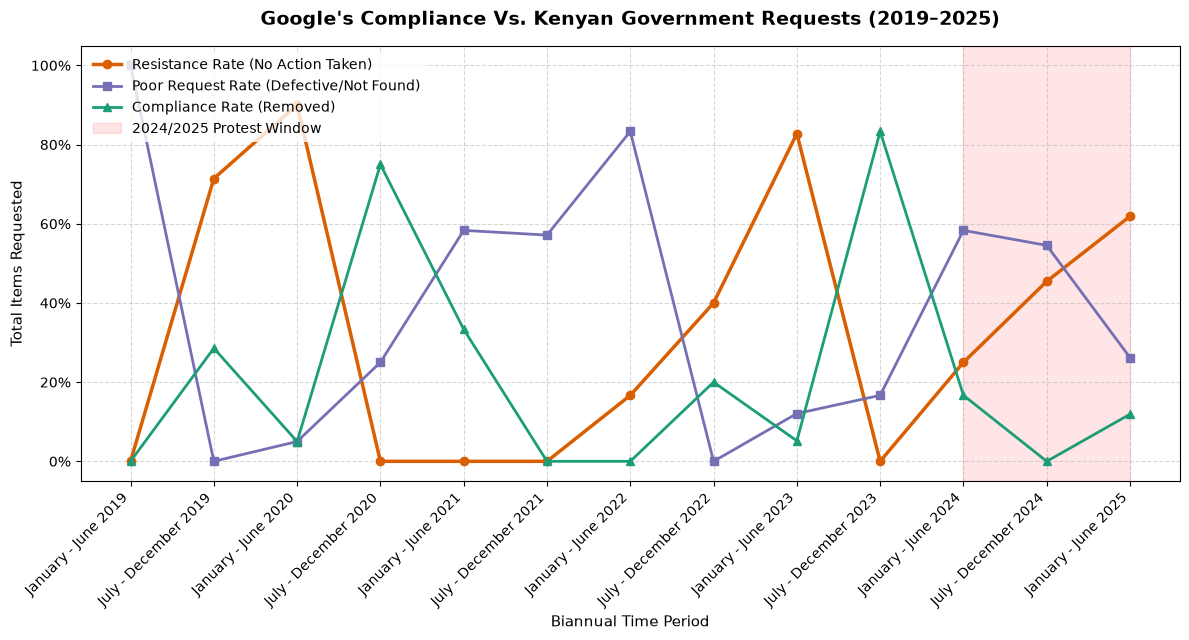
Kenya’s content removal metrics across the 2019–2025 timeline highlights a stark, defensive shift in platform-state dynamics during political friction:
Compliance: Platform compliance is inversely tied to state pressure. The Compliance Rate peaks during low-volume periods—reaching 75% in late 2020 and its historic high of 83.3% in late 2023. However, whenever state pressure escalates, compliance collapses to nearly zero (e.g., 5% in early 2020 and 0% in late 2024).
Resistance: Large state interventions trigger immediate institutional resistance. The Resistance Rate experiences sharp upward trajectories during major state crackdowns, hitting a historic apex of 90% in early 2020 and surging continuously within the 2024/2025 Protest Window to finish at 61.9% by mid-2025.
Defective Administrative Demands: A significant portion of state requests fail basic procedural thresholds. The Poor Request Rate opens at a definitive 100% in early 2019 and peaks later at 83.3% in early 2022, revealing a persistent pattern of legally vague requests targeting content that does not exist.
Overall, there’s a recurring pattern where platform compliance bottoms out during massive state censorship attempts, shifting Google’s position into aggressive resistance and procedural rejection.
                               requestor  requests  items_requested  items_removed  items_no_action  compliance_rate  resistance_rate
Information and Communications Authority        13               23              5               10         0.217391         0.434783
       Court Order directed at 3rd party         4               19              0               15         0.000000         0.789474
                                   Other         4                8              0                6         0.000000         0.750000
                    Government Officials         3                3              0                0         0.000000         0.000000

              reason  requests  items_requested  items_removed  items_no_action  compliance_rate  resistance_rate
          Defamation         6               16              0                8         0.000000         0.500000
Privacy and security         4               14              1               12         0.071429         0.857143
   National security         2                7              0                7         0.000000         1.000000
               Other         4                6              0                0         0.000000         0.000000
       Impersonation         5                5              4                1         0.800000         0.200000
            Violence         1                3              0                3         0.000000         1.000000
         Hate speech         1                1              0                0         0.000000         0.000000
Government criticism         1                1              0                0         0.000000         0.000000
An analysis of the July 2024 – June 2025 protest window reveals a state censorship apparatus driven by executive agencies and systematically checked by Google.
Executive Dominance: The Information and Communications Authority bypassed judicial channels to lead the clampdown, filing 13 requests (23 items). Google aggressively checked this push, enforcing a 43.5% resistance rate while allowing only 21.7% compliance.
Judicial Blocking: Court Orders directed at 3rd parties (19 items) were completely neutralized by the platform, resulting in 0% compliance and 78.9% explicit resistance.
Political Defiance: While Defamation and Privacy topped requested volumes, politically motivated requests faced a total platform block. National Security (7 items), Violence (3 items), and Government criticism (1 item) all returned an absolute 100% resistance rate, whereas non-political Impersonation cleared thresholds with 80% compliance.
      country  total_requests  total_items  compliance_rate  resistance_rate  poor_request_rate
        Egypt             107          227         0.392070         0.140969           0.405286
        Kenya              84          255         0.164706         0.584314           0.227451
      Nigeria              69          299         0.297659         0.314381           0.357860
      Algeria              41          130         0.738462         0.023077           0.184615
 South Africa              33           78         0.461538         0.076923           0.410256
Côte d'Ivoire              14           50         0.400000         0.280000           0.320000
     Tanzania              14           70         0.171429         0.171429           0.214286
        Ghana              12           81         0.679012         0.135802           0.185185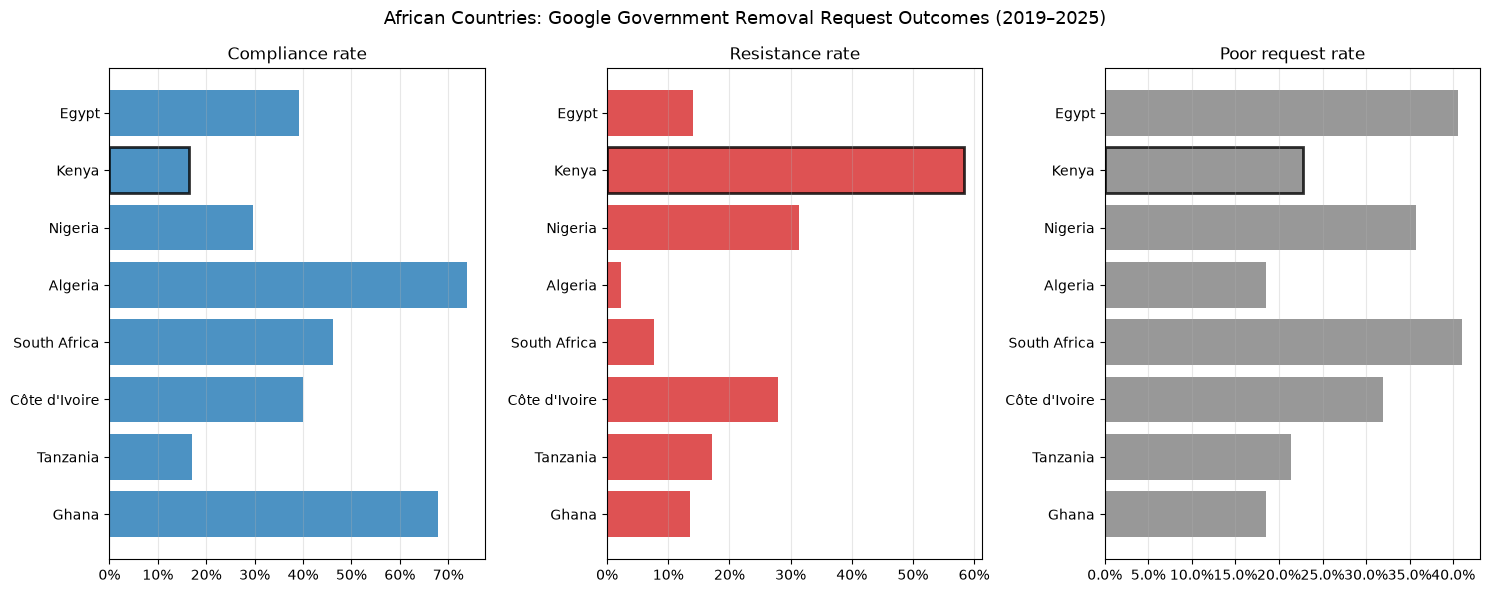
Kenya is an outlier in platform-state dynamics across Africa. It ranks second in total item demands (255), and exhibits the lowest compliance rate of the group at just 16.5%. Kenya demonstrates an unparalleled Resistance rate of 58.4%, nearly double that of the closest ountry, Nigeria (31.4%), creating a distinct pattern. Kenyan authorities frequently demand content removal, but Google systematically rejects the vast majority of these requests. While other nations like Algeria and Ghana secure high compliance rates through successful legal maneuvering, Kenya’s strategy relies on volume-heavy demands that fail to meet platform evidentiary standards, resulting in a unique cycle of high state pressure met by high platform-level institutional pushback.
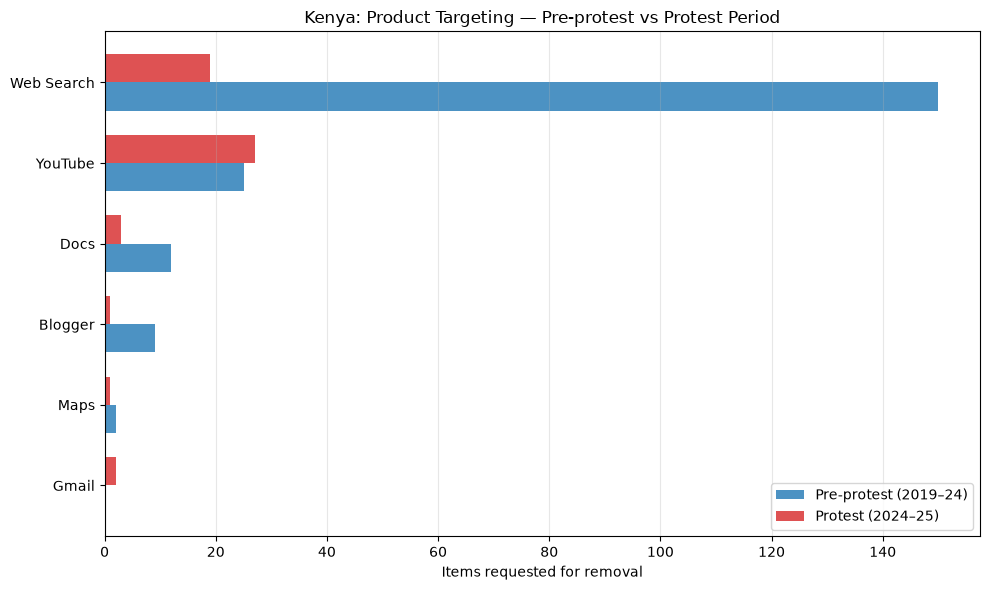
The Video Pivot: Historically, Web Search was overwhelmingly the primary focus of state intervention, accounting for approximately 150 items. However, during the protest period, Web Search demands drastically reduced to fewer than 20 items.
YouTube and Live Content Focus: Instead, YouTube emerged as the top target, overtaking Web Search with roughly 27 item requests.
Peripheral Platforms: Textual and collaborative platforms like Docs and Blogger, which collectively accounted for over 20 items historically, were largely ignored during the protests, while Gmail registered its first nominal tracking.
This highlights an intentional migration away from restricting static informational indexing towards actively suppressing highly viral, real-time multimedia content distributed during active civil unrest.
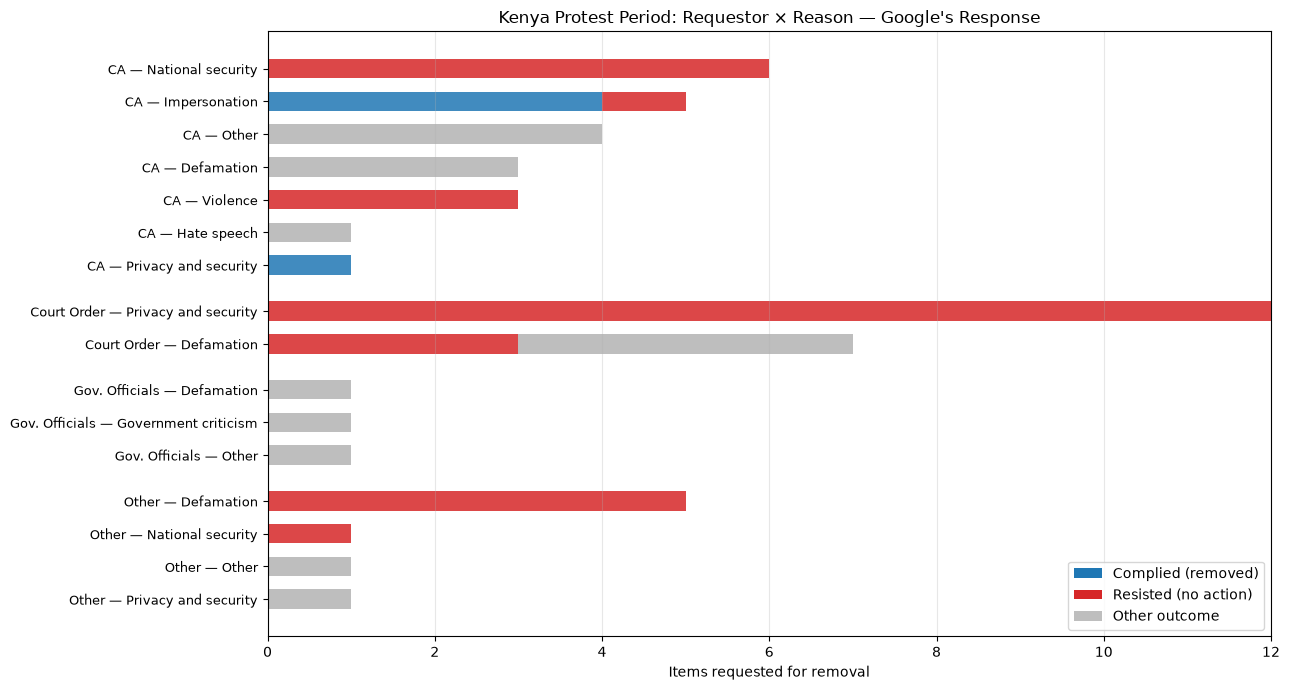
Google’s outcomes depend simultaneously on who requests content removal and why:
Compliance (Removed): Platform compliance is highly selective. It only succeeded under the Communications Authority (CA), clearing 4 items for Impersonation and 1 for Privacy and security. No other requestor secured any removals.
Resistance (No Action): Active resistance is the dominant outcome for high-volume, politically sensitive requests. Google aggressively blocked Court Order — Privacy and security (12 items) and CA — National security (6 items) with 100% resistance. It also resisted 5 items from Other — Defamation, 3 from Court Order — Defamation, 3 from CA — Violence, and 1 each for CA — Impersonation and Other — National security.
Other Outcomes: Procedural rejections (e.g., defective requests) insulated smaller requests. All demands from Gov. Officials (Defamation, Government criticism, Other) and several CA categories (Other, Defamation, Hate speech) resulted entirely in other outcomes.